If you have gone looking for a heavy metal binder, you have almost certainly run into both of these. Zeolite, usually sold as micronized clinoptilolite, and modified citrus pectin, usually abbreviated MCP, get recommended for overlapping reasons and often show up in the same protocol. They are not the same kind of thing, though. One is a mined mineral and one is a processed plant fiber, they act in different places, and their published human evidence points in different directions. Here is a straight comparison of what each has actually been shown to do.
Key Takeaways
- Zeolite is an aluminosilicate mineral that binds cations by ion exchange within the gastrointestinal tract [1]. Its strongest human finding is reduced uptake of lead ingested at the same time [2].
- Modified citrus pectin is a citrus-peel polysaccharide chemically shortened to lower molecular weight. Its human studies reported increased urinary excretion of toxic elements [3][4].
- That difference matters: gut-level binding reduces what gets in, while increased urinary output implies something already circulating is being moved out.
- Both evidence bases are small. Neither is an approved treatment for heavy metal poisoning, and neither substitutes for medical chelation.
- No published trial has tested the two in combination, so stacking protocols are built on reasoning, not data.
What Each One Actually Is
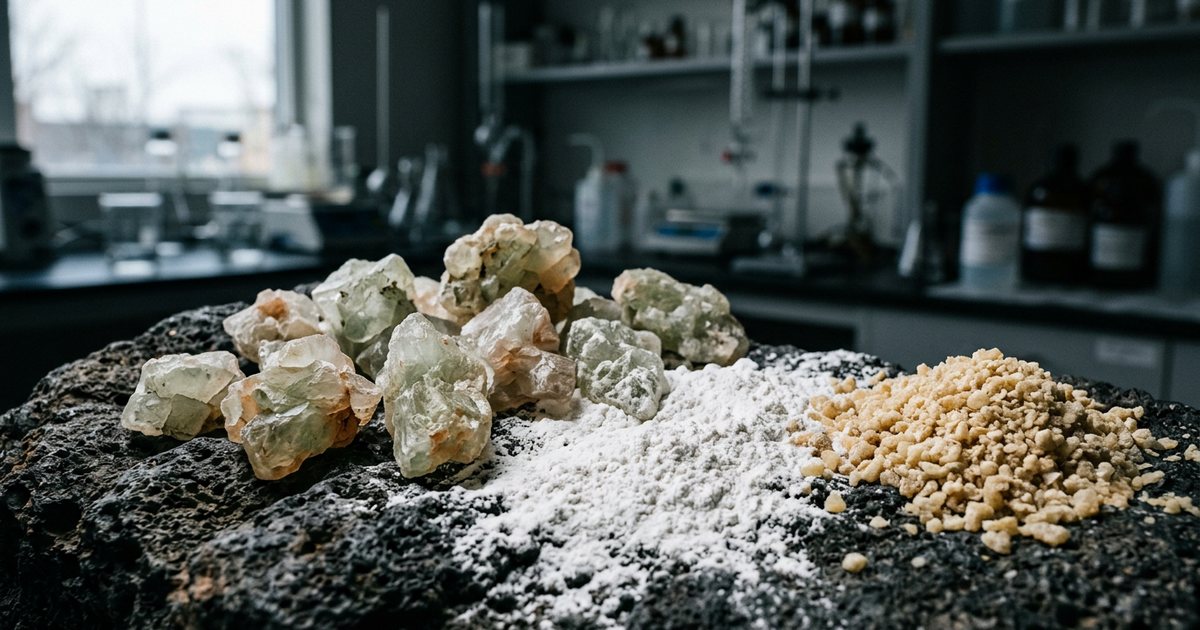
Zeolite (clinoptilolite) is a naturally occurring crystalline aluminosilicate mined from volcanic sedimentary deposits. Its framework carries a net negative charge balanced by loosely held sodium, calcium, potassium, and magnesium ions. Supplement-grade material is typically micronized to increase accessible surface area.
Modified citrus pectin starts as pectin, the soluble fiber in citrus peel and pith. Ordinary pectin is a long-chain polysaccharide that is too large and too viscous to be absorbed. Modification, usually through pH and temperature treatment, breaks those chains into shorter, lower-molecular-weight fragments. The stated rationale is that the smaller fragments can cross the gut wall and act systemically, which unmodified pectin cannot do.
That processing step is the entire basis for the difference in claimed mechanism, and it is worth understanding, because it is what separates MCP from simply eating fruit.

Mechanism: Where Each One Works
Zeolite’s documented mechanism is confined to the digestive tract. Cations dissolved in gut contents can exchange into the mineral’s pore structure and leave with it. Published work on natural zeolites confirms adsorption capacity for a range of heavy metal cations, while noting that capacity varies substantially by metal, by source deposit, and by pH [1]. Because the mineral is not shown to enter the bloodstream, whatever it binds has to be present in the gut at the same time.
Modified citrus pectin is claimed to work differently. The premise is that low-molecular-weight fragments are absorbed and can bind circulating metals, which are then filtered out by the kidneys. The human studies are consistent with that premise in the sense that what they measured was urinary output, not stool content.
This is the single most useful distinction between the two. Zeolite’s evidence is about reducing what gets absorbed. MCP’s evidence is about increasing what gets excreted in urine. Those are different endpoints, and someone deciding between them should know which question they are actually trying to answer.
The Human Evidence, Side by Side
Zeolite
The clearest human trial gave healthy adults purified clinoptilolite tuff along with lead, and measured how much lead was taken up from the gut. Co-administration reduced enteral lead uptake [2]. This is a well-designed answer to a specific question, and its limits are equally specific. It tells you about lead arriving in the digestive tract at the same time as the zeolite. It does not tell you about lead already deposited in bone or soft tissue, and it did not measure long-term body burden.

Modified Citrus Pectin
A 2006 study reported that modified citrus pectin increased urinary excretion of toxic elements in participants [3]. A 2008 report described its use in children hospitalized with toxic lead levels, framing it as an effective chelator in that setting [4].
These are the studies MCP marketing rests on, and they deserve to be read with their limitations in view. Both are small. The 2008 report involves a clinically serious population that was, by definition, also receiving medical care, which makes attribution harder. Neither has been followed by the kind of larger, independently replicated trial that would settle the question.
Practical Differences That Affect Use
- Form and dosing. Zeolite is sold as powder, capsules, or liquid drops, dosed by weight of mineral. MCP is typically a powder dosed in grams per day, often 5 grams or more, which is a meaningfully larger volume to take.
- Taste and tolerance. MCP is a soluble fiber and can cause the digestive effects fiber causes at that dose. Zeolite is generally tasteless but can be gritty depending on particle size.
- Contamination risk profile. This one is specific to zeolite. Because it is a mined mineral that binds metals, poorly sourced zeolite can arrive already carrying lead or aluminum from its deposit. Third-party certificates of analysis matter more for zeolite than for most supplements. MCP, as a plant-derived product, has the standard agricultural contamination considerations instead.
- Interaction potential. Both can bind or slow absorption of things taken alongside them. Separating either from medications and mineral supplements by a couple of hours is the standard precaution.
- Cost. MCP at effective study-level doses tends to be the more expensive of the two per month, because of the gram-scale dosing.
How to Think About Choosing
The framing that actually helps is to ask what problem you are trying to address, then check whether either substance has been studied for it.

If the concern is ongoing dietary or environmental exposure, meaning metals arriving in food or water on a regular basis, zeolite’s gut-level mechanism is at least aimed at the right target, and the human co-administration trial speaks to exactly that scenario.
If the concern is an existing measured body burden, neither product has evidence that would justify treating it as a solution. That situation calls for testing and a physician, because established chelation protocols exist, have defined pharmacology, and are monitored for a reason. The failure mode worth avoiding is spending months on a supplement while a real exposure source stays unaddressed.
And if you have not tested at all, testing is the higher-value step. Both of these products are frequently bought on suspicion rather than measurement, which makes it impossible to tell whether anything worked.
A Note on the Evidence
The human studies cited here are small, and in MCP’s case, decades old without large-scale replication. The zeolite trial addressed a narrow, well-defined question in healthy adults. Neither zeolite nor modified citrus pectin is approved by the FDA to diagnose, treat, cure, or prevent any disease, including heavy metal toxicity. Nothing here is medical advice. Clinically significant heavy metal exposure is a medical condition, and it should be diagnosed and treated by a clinician rather than self-managed.
Frequently Asked Questions
What is the main difference between zeolite and modified citrus pectin?
Mechanism and where they act. Zeolite is a mineral that works by ion exchange inside the digestive tract and is not shown to enter the bloodstream. Modified citrus pectin is a polysaccharide derived from citrus peel, processed into shorter chains, and its published human studies measured increased urinary excretion of toxic elements, which implies systemic activity rather than gut-only binding.
Which one has better human evidence?
Neither has a large, definitive evidence base. Zeolite has a controlled human trial showing reduced uptake of lead ingested at the same time. Modified citrus pectin has small human studies reporting increased urinary excretion of toxic elements, including a report in children with elevated lead. Both bodies of evidence are small, and neither substance is an approved treatment for heavy metal poisoning.
Can you take zeolite and modified citrus pectin together?
Some protocols combine them on the reasoning that they act at different points, one in the gut and one systemically. There is no published trial testing the combination, so any benefit from stacking them is theoretical. Both can affect absorption of other things you take, so separation from medications and mineral supplements is the sensible precaution.
Is modified citrus pectin a chelator?
It is often described that way, and one published paper uses that language, but it is not a pharmaceutical chelating agent in the sense that DMSA, EDTA, or succimer are. Those have defined pharmacology and approved clinical use for specific poisonings. Modified citrus pectin is a dietary supplement with a much smaller evidence base.
Should either replace medical chelation therapy?
No. Clinically significant heavy metal poisoning is a medical condition with established treatment protocols and requires diagnosis and monitoring by a physician. Neither zeolite nor modified citrus pectin has been shown to substitute for that, and delaying real treatment for a supplement is the actual risk to weigh here.
References
- Adsorption of heavy metals on natural zeolites: A review. Chemosphere (2023). PMID 36972873
- Concomitant oral intake of purified clinoptilolite tuff (G-PUR) reduces enteral lead uptake in healthy humans. Scientific Reports (2021). PMID 34285282
- The effect of modified citrus pectin on urinary excretion of toxic elements. Phytotherapy Research (2006). PMID 16835878
- The role of modified citrus pectin as an effective chelator of lead in children hospitalized with toxic lead levels. Alternative Therapies in Health and Medicine (2008). PMID 18616067
These statements have not been evaluated by the Food and Drug Administration. This information is not intended to diagnose, treat, cure, or prevent any disease. Content is for informational purposes only and is not medical advice; consult a qualified healthcare provider before starting any supplement. As an Amazon Associate we earn from qualifying purchases.
