Long before clinoptilolite showed up in detox capsules, it was filter media. Zeolite has been used in water softening, aquaculture, wastewater treatment, and pool filtration for decades, and that industrial track record is a big part of why the supplement marketing sounds so convincing. The problem is that the two uses get blended together in sales copy, and the water-treatment evidence is genuinely much stronger than the human-supplement evidence. Here is what zeolite actually does in a water system, where it is used, and why filter performance is not a claim about your body.
Key Takeaways
- Zeolite works in water by ion exchange and adsorption. Its aluminosilicate framework carries a net negative charge balanced by loosely held sodium, calcium, and potassium ions, which swap out for other cations in the surrounding water.
- The best-documented water application is ammonium removal. Natural zeolite has been validated as a pretreatment step for recovering ammonium from treated urban wastewater [1], and engineered clinoptilolite variants remove both ammonium and phosphate [2].
- Heavy metal adsorption on natural zeolites is real but highly variable, depending on the metal, the specific deposit, pH, and contact time [3].
- PFAS removal requires chemically modified zeolite, not the raw mineral [4].
- Filter performance does not transfer to oral supplementation. The strongest human clinoptilolite trial measured reduced uptake of lead taken at the same time, not removal of metals already in the body [5].
The Mechanism: Why Zeolite Works in Water at All
Zeolites are crystalline aluminosilicates with an open, cage-like framework. Because aluminum sits in some of the positions silicon would otherwise occupy, the framework carries a net negative charge. That charge is balanced by exchangeable cations, usually sodium, calcium, potassium, or magnesium, sitting loosely inside the pores.
When water flows through, those loosely held ions can trade places with cations dissolved in the water. If the incoming ion binds more strongly to the framework than the resident ion does, the swap happens and the incoming ion stays behind in the mineral. That is ion exchange, and it is the same chemistry behind a conventional water softener, which trades calcium and magnesium for sodium.
Two things follow from this. First, zeolite is selective. It does not pull everything out of water equally, because the exchange depends on ion charge, ion size relative to the pore openings, and how tightly the framework holds each species. Second, the media has a finite capacity. Once the exchangeable sites are occupied, the filter stops working until it is regenerated or replaced.
Ammonium Removal: The Strongest Water Application
Clinoptilolite has an unusually high affinity for the ammonium ion, and this is where zeolite earns its keep in water engineering. Ammonium is a problem in wastewater because it drives eutrophication downstream and because treating it biologically is energy-intensive.
Published work has validated natural zeolite as a pretreatment stage in a hybrid system designed to capture ammonium from treated urban wastewater and convert it into liquid fertilizer, turning a disposal problem into a recovered product [1]. More recent work on organo-functionalized magnetic clinoptilolite has demonstrated simultaneous removal of both ammonium and phosphate, along with data on the adsorption threshold and the likely binding mechanism [2].
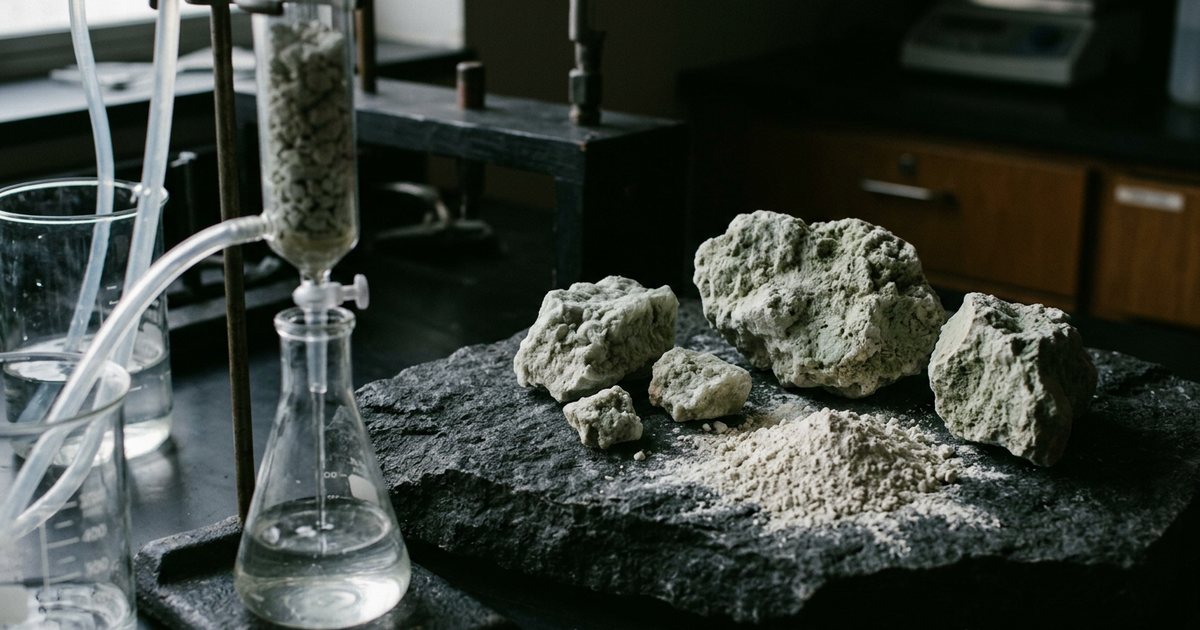
This same affinity explains the aquarium and aquaculture use. In a closed tank, fish excrete ammonia continuously, and ammonia toxicity is one of the fastest ways to lose a tank. A zeolite media bag pulls ammonium out of the water column between water changes. That is a well-understood, narrowly defined job, and it works.
Heavy Metals: Real, But Highly Variable
Heavy metal adsorption is the application supplement marketing leans on hardest, and the underlying water research does support it, with caveats. A 2023 review in Chemosphere surveyed adsorption of heavy metals on natural zeolites and found the capacity is genuine but varies substantially across metals and across zeolite sources [3].
The variables that matter in practice are worth naming, because they are the same variables that get flattened in marketing copy:
- Which metal. Lead, cadmium, copper, zinc, and nickel do not behave identically. Selectivity ordering differs by zeolite type.
- Which deposit. Natural clinoptilolite is a mined mineral. Purity, cation composition, and pore accessibility differ from mine to mine.
- pH. Adsorption of metal cations generally falls off in more acidic water, where hydrogen ions compete for the same exchange sites.
- Contact time and flow rate. Ion exchange is not instantaneous. Water moving through a cartridge too quickly does not reach equilibrium.
- Competing ions. Hard water full of calcium and magnesium occupies exchange sites that would otherwise be available for target metals.
This is why a responsible filter product cites third-party certification against a specific contaminant list rather than a general claim about the mineral category.
PFAS: Only With Modified Zeolite
PFAS contamination has pushed a lot of filter marketing to claim broad coverage, and zeolite has been swept into that. The honest position is narrower. Perfluoroalkyl acids are not simple cations, so plain cation exchange is not the relevant mechanism.
Research has shown removal of perfluoroalkyl acids from aqueous media using surfactant-modified clinoptilolite, where the mineral surface is deliberately altered to create affinity for those compounds [4]. That is a meaningful finding, and it is also a clear boundary. It applies to a chemically modified material, not to raw zeolite gravel or the clinoptilolite powder sold as a supplement.
Where Zeolite Actually Shows Up in Water Systems
- Wastewater and nutrient recovery. Ammonium capture and, in engineered forms, phosphate capture.
- Aquaculture and aquariums. Ammonium control in closed or semi-closed systems.
- Pool and spa filtration. Zeolite sand is sold as a replacement for silica sand in sand filters, marketed on finer particulate capture and some ammonia reduction.
- Well water treatment. Typically as one stage in a multi-stage system, often paired with sediment filtration and activated carbon, rather than as a standalone solution.
- Industrial process water and remediation. Including the radioactive-cesium capture work that came out of nuclear cleanup efforts.
Notice what is missing from that list: zeolite is not the standard media in municipal drinking-water plants, and it is not a substitute for disinfection. It handles specific ionic contaminants, not pathogens and not most organic chemicals.
Why Filter Performance Is Not a Health Claim
This is the part worth being direct about, because it is the exact leap most zeolite supplement copy makes. A filter and a digestive tract are not comparable environments.
In a filter, the engineer controls contact time, flow rate, pH, and media volume, and the water arriving is relatively simple. In the gut, zeolite meets stomach acid, food, bile, and an enormous background of competing dietary cations, all moving on their own schedule. Any binding that happens is competing against that.
The strongest human evidence for oral clinoptilolite reflects this. In a controlled trial in healthy adults, purified clinoptilolite tuff taken at the same time as lead reduced how much of that lead was taken up from the gut [5]. That is a real, measured, useful finding, and it is specifically about reducing uptake of a substance present in the digestive tract at the same time. It is not evidence that oral zeolite pulls metals out of tissue, out of blood, or out of storage sites elsewhere in the body.
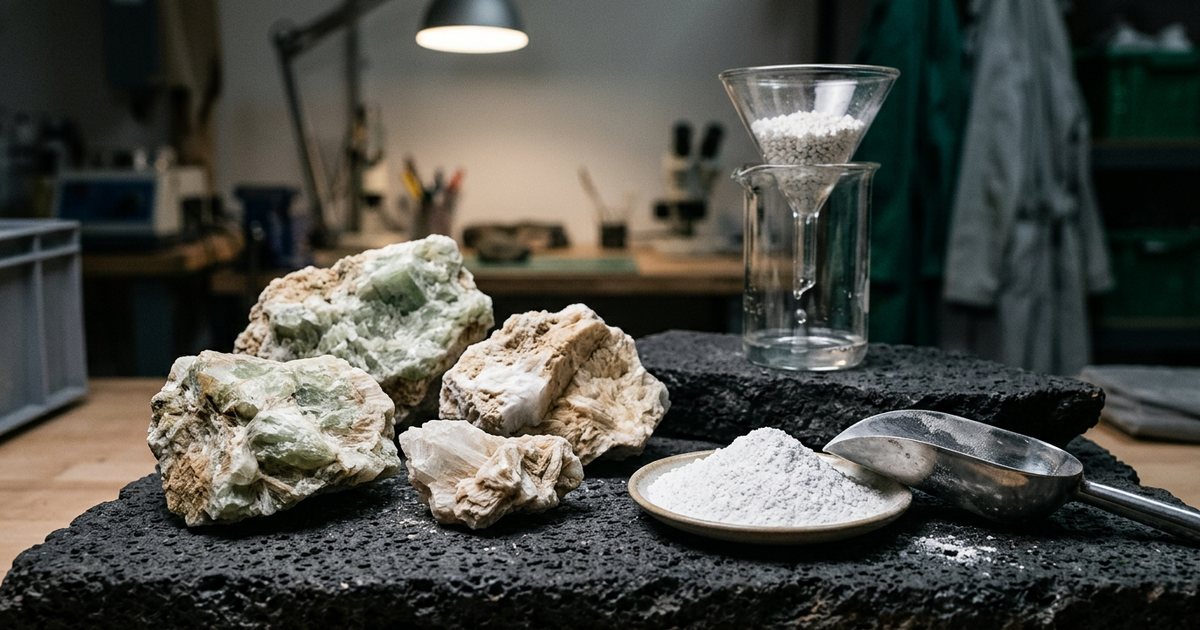
So the accurate framing is: zeolite is a well-established ion-exchange material with a legitimate and long-documented role in water treatment, and it has a much narrower, still-developing body of human evidence as a supplement. Both statements are true at once. The first does not prove the second.
A Note on the Evidence
The water-treatment literature cited here is engineering and environmental science, measuring adsorption capacity in controlled aqueous systems. Those results describe material behavior in water, not physiological outcomes in people. The single human study referenced was a trial in healthy adults measuring uptake of co-administered lead. Zeolite supplements are not approved by the FDA to diagnose, treat, cure, or prevent any disease, and nothing here is medical advice. If you are concerned about heavy metal exposure or your water quality, get your water tested by a certified laboratory and talk to a clinician about testing you.
Frequently Asked Questions
Does a zeolite water filter remove heavy metals?
Natural zeolites do adsorb several heavy metal cations from water, and this is one of the better-documented areas of zeolite research. Capacity varies widely by metal, by the specific zeolite deposit, by pH, and by how long the water contacts the media, so a general claim that a zeolite filter removes heavy metals is only meaningful alongside the certification and test data for that specific product.
Is zeolite used in municipal water treatment?
Yes, most commonly in wastewater and nutrient-recovery applications rather than at the drinking-water tap. Published work has validated natural zeolite as a pretreatment step for recovering ammonium from treated urban wastewater, and as an adsorbent for ammonium and phosphate in engineered treatment systems.
Why is zeolite used in aquarium and pond filters?
Because clinoptilolite exchanges ammonium ions out of water efficiently. Ammonia is the main acute toxicity risk in a closed aquatic system, so an ion-exchange medium that pulls ammonium out of the water column has a clear, direct use there. That is an ion-exchange function in a tank, not a claim about human physiology.
Can zeolite filter PFAS out of water?
Unmodified natural zeolite is not a recognized PFAS treatment. Research on surfactant-modified clinoptilolite has shown removal of perfluoroalkyl acids from water, but that involves chemically modifying the mineral surface, not the raw zeolite sold for filters or supplements. Do not assume a general-purpose zeolite filter addresses PFAS.
If zeolite cleans water, does taking it clean my body?
That inference does not hold. A filter cartridge holds zeolite in contact with water for a designed period, at a controlled pH, with no competing biology. Swallowed zeolite passes through a digestive tract full of competing ions, food, and acid. The human evidence for oral clinoptilolite is much narrower than the water-treatment evidence, and the strongest human trial measured reduced uptake of ingested lead, which is a different thing from removing metals already stored in tissue.

References
- Advanced Hybrid System for Ammonium Valorization as Liquid Fertilizer from Treated Urban Wastewaters: Validation of Natural Zeolites Pretreatment. Membranes (Basel) (2023). PMID 37367784
- Synchronously efficient removal of ammonium and phosphate by organo-functionalized magnetic clinoptilolite. Bioresource Technology (2026). PMID 41271120
- Adsorption of heavy metals on natural zeolites: A review. Chemosphere (2023). PMID 36972873
- Removal of perfluoroalkyl acids from aqueous media by surfactant-modified clinoptilolites. Environmental Science and Pollution Research (2024). PMID 38329667
- Concomitant oral intake of purified clinoptilolite tuff (G-PUR) reduces enteral lead uptake in healthy humans. Scientific Reports (2021). PMID 34285282
These statements have not been evaluated by the Food and Drug Administration. This information is not intended to diagnose, treat, cure, or prevent any disease. Content is for informational purposes only and is not medical advice; consult a qualified healthcare provider before starting any supplement. As an Amazon Associate we earn from qualifying purchases.
