Clinoptilolite is a naturally occurring zeolite mineral that forms through the alteration of volcanic glass in the presence of water over geological timescales. Its distinctive cage-like crystal lattice, built from aluminum and silicon tetrahedra, creates a porous structure capable of trapping cations through ion exchange.
Understanding the geological origins of clinoptilolite helps explain its variable composition, purity, and performance as a supplement.[1] Because it is a mined mineral, the specific conditions of its formation — including the parent rock chemistry, temperature, pressure, and fluid composition — directly influence its final properties and potential contaminant profile.
Key Takeaways
- Clinoptilolite forms from volcanic ash altered by alkaline fluids in lake or marine settings over geologic time.
- Its cation exchange capacity depends on the Si/Al ratio and native cations (K, Ca, Na) locked in during crystallization.
- Deposit geology controls purity: accessory minerals and heavy metals vary by source and cannot be assumed absent.[2]
- Processing (milling, heating, acid washing) changes pore structure, surface area, and metal bioavailability.
- Third-party COAs for each lot are essential — no regulatory standard defines ‘supplement-grade’ zeolite.
Volcanic Precursors: From Ash to Aluminosilicate Gel
Clinoptilolite originates from volcanic ejecta — primarily rhyolitic to dacitic ash and tuff — deposited in lacustrine (lake), marine, or shallow burial environments. When hot volcanic glass reacts with alkaline groundwater or pore fluids, it dissolves and re-precipitates as an aluminosilicate gel. This gel then crystallizes into zeolite minerals under low-temperature, low-pressure conditions typical of diagenesis.
The transformation requires a source of silica and alumina from the dissolving glass, plus alkali cations (sodium, potassium, calcium) from the interacting fluid. The ratio of silica to alumina, the pH and salinity of the fluid, and the temperature regime all steer which zeolite species nucleate and grow. Clinoptilolite typically forms in the 50–150 °C range over thousands to millions of years.
Diagenetic Environments: Lakes, Seas, and Burial Settings
Most economic clinoptilolite deposits formed in closed-basin lakes where volcanic ash accumulated and reacted with alkaline, saline waters. In these settings, evaporation concentrates dissolved ions, raising pH and driving the glass-to-zeolite reaction. Marine environments can also host zeolitization, particularly where ash falls onto carbonate-rich seafloors, but the resulting assemblages often include other zeolites such as phillipsite or analcime.

Deep burial of ash sequences can produce clinoptilolite through progressive diagenesis, where increasing temperature drives sequential mineral reactions: volcanic glass → smectite clay → clinoptilolite → analcime → feldspar. The clinoptilolite window is narrow; higher temperatures convert it to analcime or albite, while lower temperatures favor smectite. This thermal history affects crystal size, cation occupancy, and pore accessibility.
Crystal Structure and Cation Exchange Capacity
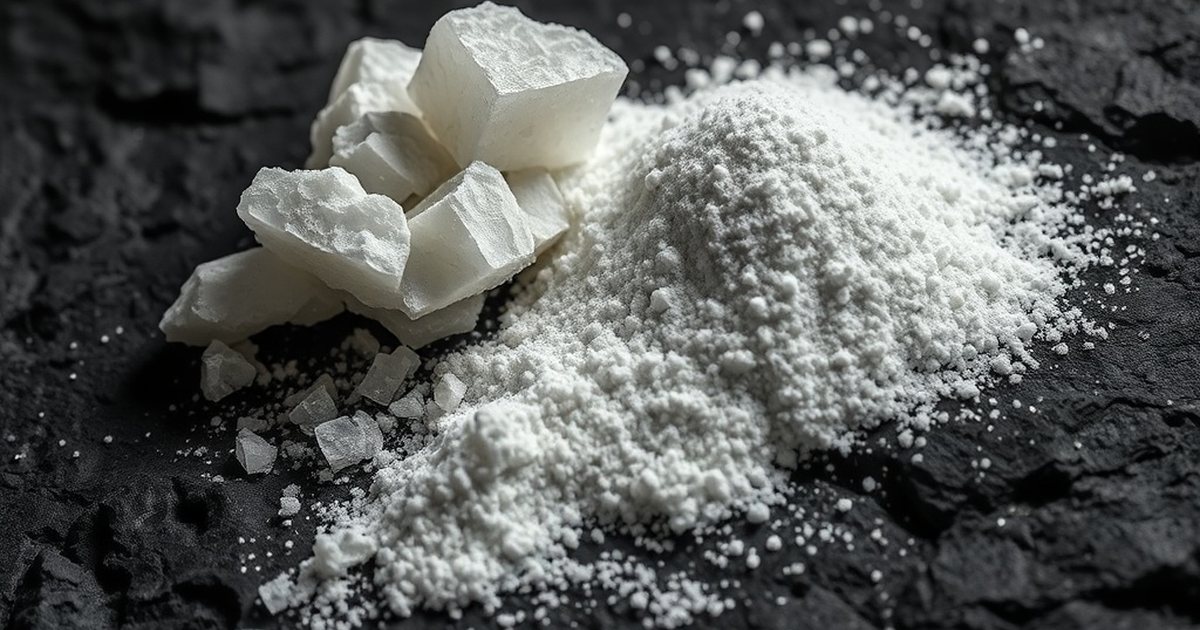
Clinoptilolite belongs to the heulandite group and crystallizes in the monoclinic system. Its framework consists of corner-sharing SiO₄ and AlO₄ tetrahedra forming interconnected channels occupied by exchangeable cations (Na⁺, K⁺, Ca²⁺, Mg²⁺) and water molecules. The aluminum substitution for silicon creates a negative framework charge balanced by these extra-framework cations.
The cation exchange capacity (CEC) of clinoptilolite typically ranges from 1.5 to 2.5 meq/g, depending on the Si/Al ratio and the nature of the occupying cations. Higher aluminum content increases CEC but can reduce hydrothermal stability. Natural clinoptilolite is usually potassium- or calcium-dominant, reflecting the fluid chemistry during formation. This native cation population is relevant for supplement use, as it determines what the material releases during ion exchange in the gut.
Geochemical Variability and Impurity Phases
No two clinoptilolite deposits are identical. The parent ash composition, fluid chemistry, temperature history, and degree of crystallinity all vary. Common accessory minerals include quartz, feldspar, smectite, opal-CT, and volcanic glass remnants. These impurities dilute the zeolite content and can introduce heavy metals such as lead, arsenic, or cadmium if the source region is mineralized.
Iron and manganese oxides often coat crystal surfaces or fill pores, reducing accessible surface area. Some deposits contain fibrous zeolites (erionite) or crystalline silica phases that pose inhalation hazards during processing. Thorough mineralogical characterization — X-ray diffraction, electron microprobe, and bulk chemistry — is essential to define what a given clinoptilolite product actually contains.

Mining, Milling, and the Micronization Factor
Clinoptilolite is typically mined by open-pit methods, then crushed, dried, and milled. Particle size reduction to micronized powder (<20 µm) increases external surface area and shortens diffusion paths for ion exchange, but it also generates respirable dust. Some producers use air classification or wet milling to control particle size distribution and reduce fines.
Mechanical activation (high-energy milling) can distort the crystal lattice, creating defects that temporarily increase cation exchange kinetics but may also release framework aluminum. Thermal treatment above 300 °C drives off channel water and can collapse pores, while acid leaching removes impurities but risks dealumination. Each processing step alters the material’s behavior in ways that are rarely disclosed on supplement labels.
Why Source Transparency and Third-Party Testing Matter
Because clinoptilolite is a mined industrial mineral repurposed for human consumption, its regulatory status is that of a dietary ingredient, not a drug. The FDA has not evaluated zeolite for any health claim. Heavy metal contamination — particularly lead, arsenic, and cadmium — varies by deposit and processing, and there is no universal purity standard for supplement-grade zeolite.
Third-party certificates of analysis (COAs) reporting total metals, microbial limits, and mineralogical identity (XRD confirmation of clinoptilolite vs. other phases) provide the only objective verification. Consumers should request lot-specific COAs and favor suppliers who disclose the mine location, processing methods, and particle size specifications. Without this transparency, product quality is unverifiable.

🛒 Where to Buy Zeolite (Clinoptilolite)
- CleanseParasites Heavy Metal + Microplastics Binder Editor’s Pick
Contains zeolite alongside milk thistle, spirulina, and other binder herbs. - Touchstone Essentials Pure Body Extra Strength Zeolite
liquid, 1 tbsp (15 mL) — Best-known liquid nano-zeolite brand; MLM pricing but widely trusted in alt-health community - BodyBio Zeolite Powder
powder, 1/2 tsp — Practitioner-oriented brand, micronized clinoptilolite powder - Pure Zeolite Zeolite Powder (Ultimate Detox Clay)
powder, 1/4-1 tsp — Budget-friendly micronized powder - Zeo Health ZeoCharge
powder, 1/2 tsp — Long-standing niche zeolite brand, ultra-fine micronized clinoptilolite
As an Amazon Associate we earn from qualifying purchases. Quality varies widely — always choose a product with a published third-party test (COA) before buying.
A Note on the Evidence
The FDA has not evaluated clinoptilolite for any health claim. Human clinical evidence is limited to a few trials measuring blood mineral and metal levels, which also found raised blood lead in some supplemented groups (the authors linked it to bone remodeling), not whole-body heavy metal detoxification.[3] Because zeolite is a mined mineral, contamination with lead or other heavy metals varies by source and processing; third-party COA verification matters more than for most supplements. Consult a healthcare professional before use, especially if pregnant, nursing, or taking medications.
Frequently Asked Questions
Is all clinoptilolite the same regardless of where it's mined?
No. The parent ash chemistry, alteration fluid, temperature history, and degree of crystallinity differ between deposits, producing variations in Si/Al ratio, cation population, impurity phases, and heavy metal content.
Can clinoptilolite form quickly, or does it require millions of years?
Natural clinoptilolite typically requires thousands to millions of years at low temperatures (50–150 °C). Laboratory synthesis can accelerate the process to days or weeks under controlled hydrothermal conditions, but natural deposits reflect slow diagenesis.

Why does the cation form (sodium vs. calcium vs. potassium) matter for supplements?
The native cation determines what is released during ion exchange in the gut. Calcium- or potassium-form clinoptilolite releases those essential minerals; sodium-form releases sodium. The starting cation also affects selectivity for heavy metals.
Are there safety concerns with inhaling zeolite powder?
Yes. Fine particulate dust from any mineral can irritate the respiratory tract. Some deposits contain fibrous zeolites (e.g., erionite) or crystalline silica, which pose greater inhalation hazards. Proper handling and low-dust formulations reduce risk.
How can I verify a zeolite supplement's purity and identity?
Request a lot-specific third-party certificate of analysis (COA) showing total heavy metals (Pb, As, Cd, Hg), microbial limits, and X-ray diffraction confirmation that the material is predominantly clinoptilolite. Mine disclosure and processing details add further transparency.
Does geological origin affect how well clinoptilolite binds heavy metals in the body?
Indirectly, yes. The Si/Al ratio, cation form, crystallinity, particle size, and pore accessibility — all set by geology and processing — govern ion exchange capacity and kinetics. However, human clinical data on whole-body heavy metal detoxification are lacking.
References
- Zeolite Clinoptilolite: Therapeutic Virtues of an Ancient Mineral. Molecules (2019). PMID 30999685
- Critical Review on Zeolite Clinoptilolite Safety and Medical Applications in vivo. Frontiers in Pharmacology (2018). PMID 30538633
- Clinical Evaluation of a Defined Zeolite-Clinoptilolite Supplementation Effect on the Selected Blood Parameters of Patients. Frontiers in Medicine (2022). PMID 35712111
These statements have not been evaluated by the Food and Drug Administration. This information is not intended to diagnose, treat, cure, or prevent any disease. Content is for informational purposes only and is not medical advice; consult a qualified healthcare provider before starting any supplement. As an Amazon Associate we earn from qualifying purchases.