Clinoptilolite is a naturally occurring zeolite, a mineral built from a repeating lattice of silicon, aluminum, and oxygen atoms that forms a microscopic honeycomb of channels and cages. That structure is the entire reason zeolite is marketed for gut and detox support: the cage geometry lets loosely held sodium, potassium, and calcium ions sit inside the framework and swap places with other positively charged ions that pass by, a process called ion exchange.
This article explains the mechanism in plain terms: what the lattice looks like, why it selectively favors certain ions, and where the science stops and the marketing starts. None of this is medical advice, and no human clinical evidence supports zeolite as a whole-body heavy-metal detoxifier.
Key Takeaways
- Clinoptilolite zeolite’s cage-like lattice carries a slight negative charge that holds loosely bound ions like sodium and calcium in place through ion exchange.
- Ion exchange lets zeolite trade those ions for others it encounters, such as ammonium, which is the basis for gut-support claims, not for verified whole-body detoxification.
- Selectivity for a given ion depends on cage size and charge, so industrial water-treatment performance does not equal proven human detox effects.
- Because zeolite is a mined mineral, contamination with lead or other heavy metals varies by source, making third-party COA verification especially important.
- The FDA has not evaluated zeolite for any health claim, and human evidence is limited to small trials on gut/immune markers plus one placebo-controlled zeolite trial showing reduced absorption of co-ingested lead[1], not systemic detoxification.
What the Crystal Lattice Actually Looks Like
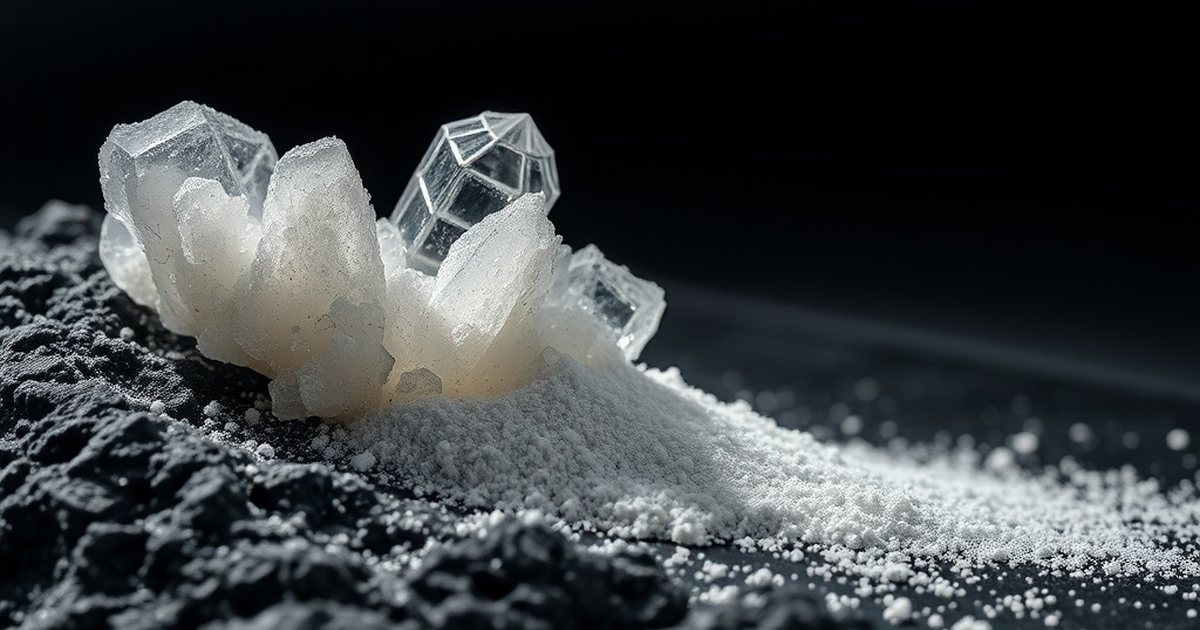
Clinoptilolite belongs to a family of minerals called aluminosilicates. Picture a scaffold of silicon and aluminum atoms, each connected to four oxygen atoms, linked together into a three-dimensional framework. Instead of being solid, this framework encloses regularly spaced channels and cage-like pockets, similar in concept to a rigid sponge at the atomic scale.
Because some silicon atoms in the framework are replaced by aluminum, the overall lattice carries a slight negative charge. To stay electrically neutral, the structure holds loosely bound positive ions, mainly sodium, potassium, calcium, and magnesium, inside its channels. Those ions aren’t locked in place; they sit there because opposite charges attract, which is exactly what makes them exchangeable.
Ion Exchange: Swapping One Charged Particle for Another
Ion exchange is a straightforward chemical principle: when a mineral’s loosely held ions come into contact with a solution containing different ions of the same charge, some of them trade places. The zeolite framework doesn’t change; only which ions are parked in its cages changes.

In the gut, this means the sodium or calcium ions sitting in zeolite’s cages can be released and replaced by other cations present in digestive fluid, such as ammonium (a byproduct of protein breakdown and bacterial activity) or, in principle, certain heavy metal cations. The exchange is not selective enough to be assumed harmless in either direction: human monitoring by ICP-MS across three supplementation trials found copper reduced in supplemented osteoporosis patients, and sodium and calcium falling below reference values, which is the same chemistry acting on nutrients rather than on toxins[2]. This is the proposed basis for zeolite’s use as a gut-support or ‘detox’ supplement: the idea that it acts as a scavenger, picking up unwanted cations as it passes through.
Selectivity: Why Zeolite Doesn't Bind Everything Equally
Not all cages in the clinoptilolite framework are the same size, and not all ions are equally attracted to them. The channel diameter, the local charge density, and the hydration shell around each ion all affect how tightly a given ion is held. This is why clinoptilolite has documented affinity for ammonium and certain heavy metal ions in industrial and environmental settings (its largest real-world use is in water treatment and agricultural ammonia control), but that affinity in a beaker or a treatment plant does not automatically translate to predictable, quantified binding inside the variable, food-filled, motility-driven environment of the human gut.
This distinction matters: laboratory or wastewater ion-exchange performance is not the same claim as ‘this capsule removes heavy metals from your body.’ The chemistry of the mineral is real, and it has now been demonstrated inside a human gut, not only in a beaker — but for one specific step. Given a traceable lead isotope in water, purified clinoptilolite-tuff taken in the same swallow reduced how much of that lead reached the bloodstream by about 90% in a randomised placebo-controlled trial of 42 adults[1]. That is ion exchange doing exactly what the mechanism predicts, at the point of absorption. It is still not evidence of systemic detoxification, because the metal never entered the body in the first place; nothing was retrieved from tissue.
What This Means for Gut and Immune Markers
The gut-support argument for zeolite rests on the idea that binding ammonium, and possibly adsorbing certain microbial byproducts or irritants at the mucosal surface, could calm gut irritation or shift the local ion balance in a way that’s measurable on small trials of gut or immune markers. This is a narrower and more testable claim than ‘detoxification,’ and it’s the area where limited human data exists — with mixed results worth stating plainly. A randomised, double-blind, placebo-controlled trial of purified clinoptilolite-tuff in 30 patients with diarrhoea-predominant IBS missed its primary endpoint: 21% of the treated group reported relief versus 25% on placebo. Some secondary measures did move, including daily abdominal pain and days with diarrhoea per week, and no treatment-related serious adverse events occurred[3]. A trial whose main question came back negative is not a foundation for a detox claim.
Even here, the evidence base is small and early rather than large or repeated. Zeolite’s proposed benefit to gut and immune markers should be read as a hypothesis under investigation, not an established effect.

Why Source and Purity Change the Equation
Because clinoptilolite is a mined mineral rather than a synthesized compound, its composition varies by geological deposit and by how it’s milled and processed afterward. The same ion-exchange cages that can bind ammonium or trace nutrients can also, depending on the deposit, contain trace lead, arsenic, or other contaminants naturally present in the source rock.
This is different from most synthetic or fermentation-derived supplements, where contamination is mostly a manufacturing-control issue. With zeolite, contamination risk starts at the quarry. A third-party certificate of analysis (COA) confirming heavy metal testing on the specific batch is a meaningfully more important checkpoint here than it is for most supplement categories.
Regulatory and Evidence Status
The FDA has not evaluated clinoptilolite zeolite for any health claim, and it is sold as a dietary supplement, not a drug. That means there is no requirement for the pre-market efficacy or safety testing a drug would undergo.
Human clinical evidence is limited to small trials looking at gut or immune markers plus one placebo-controlled zeolite trial showing reduced absorption of co-ingested lead[1], not whole-body heavy-metal detoxification. Claims describing zeolite as pulling heavy metals or toxins out of the whole body are not supported by the evidence available and should be treated skeptically regardless of how the mechanism is described.

🛒 Where to Buy Zeolite (Clinoptilolite)
- CleanseParasites Heavy Metal + Microplastics Binder Editor’s Pick
Contains zeolite alongside milk thistle, spirulina, and other binder herbs. - Touchstone Essentials Pure Body Extra Strength ZeoliteLab-tested / studied
liquid, 1 tbsp (15 mL) — Best-known liquid nano-zeolite brand; MLM pricing but widely trusted in alt-health community, publishes third-party lab testing - BodyBio Zeolite Powder
powder, 1/2 tsp — Practitioner-oriented brand, micronized clinoptilolite powder with published COA - Pure Zeolite Zeolite Powder (Ultimate Detox Clay)
powder, 1/4-1 tsp — Budget-friendly micronized powder, third-party heavy metal tested - Zeo Health ZeoCharge
powder, 1/2 tsp — Long-standing niche zeolite brand, ultra-fine micronized clinoptilolite
As an Amazon Associate we earn from qualifying purchases. Quality varies widely — always choose a product with a published third-party test (COA) before buying.
A Note on the Evidence
This article describes a proposed mineral mechanism and is not medical advice; human evidence for zeolite is limited to small trials on gut/immune markers plus one placebo-controlled zeolite trial showing reduced absorption of co-ingested lead[1], not detoxification, and anyone with kidney issues, on medication, or considering zeolite for a medical condition should consult a doctor and verify product purity via third-party COA first.
Frequently Asked Questions
What makes zeolite's structure different from other minerals?
Its framework of silicon, aluminum, and oxygen forms open channels and cages rather than a solid crystal, and a slight negative charge in that framework holds loosely bound positive ions in place. That open, charged structure is what allows ion exchange to happen.
Does ion exchange mean zeolite pulls toxins out of the body?
Ion exchange is a real, well-understood chemical process, but the human evidence for whole-body heavy-metal detoxification does not exist. Clinical evidence in humans is limited to small trials on gut and immune markers plus one placebo-controlled zeolite trial showing reduced absorption of co-ingested lead[1], not systemic detox claims.

Why does zeolite bind ammonium?
Ammonium ions fit the size and charge profile of certain zeolite cage sites well, which is why clinoptilolite is widely used in water treatment and agriculture to control ammonia. This affinity is documented outside the human body, not confirmed as a quantified gut effect.
Is all zeolite supplement-grade the same purity?
No. Because it’s a mined mineral, composition and contamination risk vary by deposit and processing method. A product’s purity depends on its specific source and testing, not on the zeolite category as a whole.
Should I check for a certificate of analysis before buying zeolite?
Yes. Because heavy metal contamination in zeolite originates from the source rock itself, not just manufacturing, a third-party COA confirming heavy metal testing on the specific batch matters more here than for many other supplement types.
Has the FDA approved zeolite for detox or gut health?
No. The FDA has not evaluated zeolite for any health claim. It is sold as a dietary supplement without pre-market efficacy review, and any health claims made about it should be weighed against that regulatory status.
References
- Samekova K et al. Concomitant oral intake of purified clinoptilolite tuff (G-PUR) reduces enteral lead uptake in healthy humans. Scientific reports (2021). PMID 34285282
- Kraljević Pavelić S et al. Clinical Evaluation of a Defined Zeolite-Clinoptilolite Supplementation Effect on the Selected Blood Parameters of Patients. Frontiers in medicine (2022). PMID 35712111
- Anderle K et al. Safety and efficacy of purified clinoptilolite-tuff treatment in patients with irritable bowel syndrome with diarrhea: Randomized controlled trial. World journal of gastroenterology (2022). PMID 36569277
These statements have not been evaluated by the Food and Drug Administration. This information is not intended to diagnose, treat, cure, or prevent any disease. Content is for informational purposes only and is not medical advice; consult a qualified healthcare provider before starting any supplement. As an Amazon Associate we earn from qualifying purchases.